Corporate events have changed significantly. Companies are no longer limited to conference rooms, hotel meetings and traditional office parties. Many organisations now look for experiences that allow employees to interact differently, participate together and take a break from their normal work environment.
This is where adventure parks for corporate events can become an interesting option.
Adventure activities such as obstacle courses, rope challenges, ziplining, climbing, treasure hunts and team competitions can create situations where employees have to communicate, cooperate and make decisions together.
Corporate team-building providers in India commonly position outdoor adventure experiences around objectives such as trust, communication, collaboration, engagement and problem-solving.
However, an important distinction should be made: an adventure activity by itself does not automatically create a better team. The activity, group structure, facilitation and post-activity discussion all influence the experience.
What Is a Corporate Adventure Park Event?
A corporate adventure park event is a company-organised outing where employees participate in recreational or adventure-based activities as part of an:
- Employee engagement program
- Team outing
- Corporate offsite
- Annual event
- Team-building program
- Leadership activity
- Reward or recognition event
- Department gathering
The event can last a few hours, a full day or, when combined with accommodation and travel, become part of a longer corporate retreat.
The important point is that the adventure park becomes the experience environment, while the company’s objective may be bonding, relaxation, team interaction or simply giving employees a memorable break.
Why Do Companies Choose Adventure Parks?
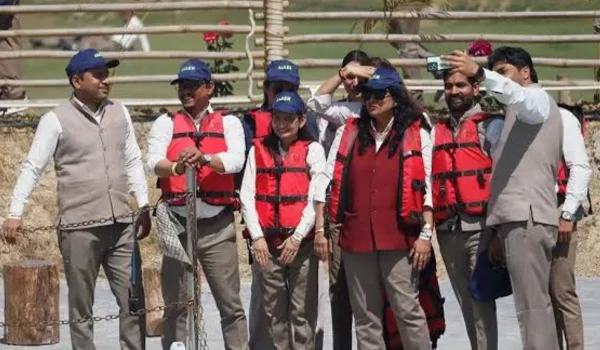
- Employees Get Away from the Office Environment
The office naturally creates familiar patterns.
Employees usually interact with the same colleagues, sit in the same teams and follow established routines.
An adventure park changes that environment.
Instead of:
Meeting room → Presentation → Discussion → Lunch
the day might involve:
Challenge → Team activity → Competition → Adventure → Food → Informal interaction
This change can encourage employees to interact with colleagues they may not normally work with.
Corporate-event providers in India increasingly offer outdoor programs specifically designed to take employees outside their usual work environment.
- Adventure Activities Encourage Teamwork
Many adventure activities cannot be completed effectively through individual effort alone.
Consider a team obstacle challenge.
Participants may need to:
- Divide responsibilities
- Communicate instructions
- Encourage teammates
- Manage time
- Decide who does what
- Adapt when something does not work
The activity creates a shared objective.
Instead of discussing teamwork theoretically, employees experience a situation where cooperation becomes practically useful.
- Communication Becomes More Important
Adventure challenges can require quick communication.
For example, a team may need to guide a participant through an obstacle or solve a clue-based challenge.
Team members may need to communicate:
What should we do?
Who should go first?
Which strategy should we use?
How much time do we have?
This can create a different communication environment from normal workplace conversations.
Corporate adventure programs commonly use obstacle challenges, treasure hunts and similar activities to encourage communication and collaborative problem-solving.
- Employees Discover Different Strengths
People behave differently outside their normal job roles.
Someone who is quiet during meetings may become an excellent strategist during a team challenge.
A junior employee may discover a solution that others overlooked.
A manager may naturally take a supportive rather than directive role.
An adventure activity can therefore reveal different forms of:
- Leadership
- Creativity
- Problem-solving
- Patience
- Decision-making
- Encouragement
- Adaptability
This does not mean one activity can accurately measure someone’s workplace performance. Rather, it creates an informal environment where different behaviours can emerge.
- It Can Break Departmental Silos
Large organisations often have employees divided into:
- Sales
- Marketing
- Finance
- HR
- Operations
- Technology
- Customer service
Employees from different departments may rarely interact meaningfully.
A mixed-team adventure activity can bring them together around a common objective.
For example:
Finance + HR + Sales + Technology
could become one team competing in a treasure hunt or obstacle challenge.
The shared experience can provide a natural conversation starter beyond normal job responsibilities.
- Adventure Activities Create Shared Memories
A corporate event becomes more memorable when employees have a story to tell afterward.
It could be:
- Completing a difficult obstacle
- Solving a treasure-hunt clue
- Winning a team challenge
- Supporting a nervous colleague
- Finishing a group race
- Laughing over an unexpected moment
These shared memories can become part of the informal culture of a workplace.
Corporate event providers often emphasise shared experiences and memorable activities as part of employee engagement programs.
- Adventure Parks Offer More Than One Activity
One advantage of an adventure park is variety.
A corporate group can potentially combine several experiences.
For example:
Morning
Team obstacle challenge
Midday
Lunch and relaxation
Afternoon
Zipline or rope course
Later
Treasure hunt or group competition
Evening
Dinner or informal gathering
This variety can be useful because employees have different preferences and physical abilities.
Not everyone wants a high-adrenaline activity.
- Not Everyone Has to Do Extreme Adventure
A common misconception is that a corporate adventure event requires everyone to participate in the most challenging activity.
That is not necessary.
A well-designed corporate program can include different levels.
Low intensity
- Treasure hunt
- Nature walk
- Team games
- Archery
- Creative challenges
Moderate intensity
- Obstacle course
- Rope challenges
- Group races
- Climbing
Higher intensity
- Ziplining
- High-rope courses
- Advanced climbing
- Other activity-specific challenges
This allows companies to create a more inclusive event.
- Adventure Parks Can Support Leadership Activities
Adventure experiences can also be incorporated into leadership-focused events.
For example, a challenge might require participants to:
- Understand a problem
- Develop a strategy
- Assign responsibilities
- Execute the plan
- Adapt to unexpected difficulties
- Review the outcome
This structure can create an experiential learning opportunity.
However, the activity should not be treated as a scientific assessment of leadership ability. Its value is primarily in creating a practical situation for discussion and reflection.
- Problem-Solving Becomes Part of the Experience
Some adventure activities are physical.
Others are primarily mental.
Treasure hunts, strategy games and team puzzles can require participants to:
- Analyse information
- Identify patterns
- Share ideas
- Prioritise tasks
- Make decisions
- Work under time pressure
This makes adventure parks useful even for teams that do not want highly physical activities.
- Corporate Events Can Combine Fun and Learning
The best corporate adventure programs often balance three elements:
Fun + Challenge + Reflection
For example:
Fun
Employees enjoy the activity.
Challenge
Teams have to work together to complete it.
Reflection
Afterwards, participants discuss what happened.
A facilitator might ask:
- What worked?
- Where did communication break down?
- Who took initiative?
- How did the team respond to failure?
- What could have been done differently?
This final step can turn an ordinary outing into a more structured team-building experience.
- Adventure Parks Can Work for Different Company Sizes
Adventure events can be designed for different group sizes, depending on the park’s capacity.
Small Team
10–30 employees
Possible activities:
- Team challenges
- Climbing
- Treasure hunts
- Rope activities
Medium Group
30–100 employees
Possible format:
- Multiple teams
- Rotating activities
- Team competitions
- Group lunch
Large Corporate Group
100+ employees
A larger event may require:
- Multiple activity stations
- Scheduled rotations
- Separate team zones
- Dedicated event coordination
- Staggered meals
- Crowd and queue management
The exact capacity depends on the park and activity design.
- Competition Can Increase Engagement
Some companies add friendly competition.
For example:
| Team | Challenge | Points |
| Team A | Obstacle Course | 80 |
| Team B | Obstacle Course | 70 |
| Team C | Obstacle Course | 90 |
| Team D | Obstacle Course | 75 |
Points can then be combined across several activities.
The final winner could receive:
- Trophies
- Medals
- Certificates
- Small prizes
- Recognition during dinner
The competition should remain friendly and should not pressure employees into activities they are uncomfortable performing.
- Adventure Parks Can Help Employees Relax
Corporate events do not always have to be about productivity.
Sometimes employees simply need a break.
An adventure park can provide:
- Physical activity
- Outdoor time
- Informal conversations
- Entertainment
- Fresh surroundings
- A break from screens
This can make the event feel more like a genuine employee experience rather than another work assignment.
- Why Employees May Prefer Adventure Experiences
A traditional corporate event might involve sitting for several hours.
An adventure event can provide more movement and participation.
Employees may:
- Walk
- Climb
- Compete
- Explore
- Solve challenges
- Talk informally
- Take photographs
- Celebrate together
This makes the experience more interactive.
- Adventure Parks Can Be Combined with Resorts
Some adventure destinations are located within or near resort properties.
This allows companies to combine:
Adventure + Accommodation + Food + Meetings + Recreation
A corporate group could therefore hold a short meeting in the morning, participate in adventure activities in the afternoon and have dinner together in the evening.
This format is particularly useful for companies organising multi-day offsites.
- Safety Is a Major Corporate Consideration
Companies cannot choose an adventure venue based only on how exciting its activities look.
Corporate HR, administration and event teams should also examine:
- Activity-specific safety procedures
- Equipment
- Staff training
- Participant restrictions
- Emergency arrangements
- First-aid provisions
- Weather policies
- Applicable licences and permissions
- Insurance arrangements where relevant
India’s National Strategy for Adventure Tourism recognises that adventure activities involve inherent risks and calls for providers to manage those risks appropriately. It also identifies safety-management standards and guidelines covering land, air and water-based activities.
In March 2026, the Ministry of Tourism stated that Model Adventure Safety Guidelines had been circulated to States and Union Territories for adoption or updating of safety protocols, and asked States/UTs to ensure adherence to safety regulations and licensing norms.
For a corporate event, safety should therefore be treated as a selection criterion, not an afterthought.
- The Event Should Be Inclusive
A company may have employees with very different:
- Ages
- Fitness levels
- Physical abilities
- Comfort levels
- Medical considerations
- Adventure experience
A good corporate program should not make participation dependent on being physically strong.
Companies can request a mix of:
Physical + Mental + Creative + Social activities
This gives more employees an opportunity to participate meaningfully.
- Adventure Activities Should Not Be Forced
Employees should not feel pressured to participate in activities they cannot or do not want to undertake.
For example, an employee may be uncomfortable with heights.
Instead of forcing that person onto a zipline, the event can provide another activity such as:
- Treasure hunt
- Team strategy game
- Archery
- Photography challenge
- Nature activity
- Ground-based obstacle
This is especially important for large corporate groups.
- Why Adventure Parks Can Be Better Than a Traditional Picnic
A picnic generally provides:
Food + Conversation + Relaxation
An adventure event can provide:
Food + Conversation + Challenge + Teamwork + Shared Experience
Neither format is inherently better.
But if a company wants employees to actively interact rather than simply sit together, an adventure park can offer more structured opportunities for participation.
- What Types of Corporate Events Suit Adventure Parks?
Adventure parks can work particularly well for:
Team Outings
Designed mainly for relaxation and bonding.
Team Building
Activities are selected around collaboration and communication.
Annual Offsites
Adventure activities are combined with food, meetings and entertainment.
Leadership Retreats
More structured challenges and facilitated reflection.
Employee Rewards
Adventure experiences can be used as recognition or incentive events.
New-Team Integration
Useful when employees from different locations or departments need opportunities to interact.
Corporate-event providers in India currently offer adventure-based formats across these kinds of objectives, including employee engagement, leadership programs and corporate offsites.
- Example of a Corporate Adventure Day
A simple one-day program could look like this:
| Time | Activity |
| 9:30 AM | Arrival & welcome |
| 10:00 AM | Safety briefing |
| 10:30 AM | Team formation |
| 11:00 AM | Team challenge |
| 12:30 PM | Adventure activity rotation |
| 1:30 PM | Lunch |
| 2:30 PM | Treasure hunt |
| 4:00 PM | Final team challenge |
| 5:00 PM | Results & recognition |
| 5:30 PM | Departure |
This is only an illustrative schedule. Actual timing depends on the group size, venue and activities.
- How Companies Can Choose the Right Adventure Park
Before booking, companies should consider:
Location
How long will employees need to travel?
Capacity
Can the park handle the complete group without excessive queues?
Activity Mix
Are there activities for different ability levels?
Safety
Are appropriate procedures, trained staff and emergency arrangements available?
Facilities
Does the park provide:
- Food
- Toilets
- Seating
- Parking
- Changing areas
- Meeting spaces where required?
Weather
What happens if outdoor activities are affected by rain or extreme weather?
Accessibility
Can employees with different mobility or participation needs be accommodated?
Event Coordination
Does the park have dedicated staff to coordinate corporate groups?
- The Best Corporate Adventure Event Is Not Necessarily the Most Extreme
This is an important point.
A company does not need the highest zipline, most difficult climbing wall or most physically demanding obstacle course to create a good event.
The better question is:
What experience suits this particular team?
For a mixed group, a combination of:
- Easy adventure
- Team challenges
- Problem-solving
- Food
- Relaxation
- Informal interaction
may produce a better experience than a day filled exclusively with extreme activities.
- Adventure Parks Can Create a Stronger Shared Experience
The biggest advantage of an adventure-based corporate event is the shared experience.
Employees who solve a problem together, complete a challenge or support each other through an unfamiliar activity may leave with a common story.
That shared memory can be more meaningful than another routine corporate gathering.
But the activity itself is only one part of the equation.
Good planning + suitable activities + inclusive participation + safety + reflection = better corporate experience
Final Takeaway
Companies choose adventure parks for corporate events because they offer something that conventional meetings often cannot: active, shared experiences outside the normal workplace environment.
Adventure activities can encourage communication, teamwork, problem-solving, informal interaction and memorable moments. They can also be adapted for different objectives—from a relaxed employee outing to a structured team-building or leadership program.
However, the best corporate adventure event is not necessarily the most extreme one.
It is the one that matches the company’s objective, employee profile, group size and comfort level, while maintaining proper safety and operational planning.
For companies considering an adventure park, the ideal approach is to look beyond the activity list and ask:
Will our employees enjoy it?
Can everyone participate in some meaningful way?
Is the venue equipped to handle our group safely?
Does the experience fit the purpose of our event?
When those questions are answered well, an adventure park can become much more than a day away from the office—it can become a memorable shared experience for the team.