An adventure park may have beautiful land, exciting activities and strong visitor demand, but there is one question that can determine whether the park operates smoothly or struggles during busy periods:
How many visitors can the park actually handle?
This is the purpose of adventure park capacity planning.
Capacity planning is not simply about calculating how many people can physically fit inside the property. A commercially successful adventure park must consider the capacity of its activities, queues, pathways, staff, parking, food outlets, toilets, ticketing systems and emergency infrastructure.
A park may have enough land for 1,000 people but still be unable to safely and comfortably serve 1,000 visitors if its activities can process only a fraction of that number.
Therefore, the real objective is:
Maximum Safe Capacity + Efficient Visitor Flow + Sustainable Revenue
What Is Adventure Park Capacity?
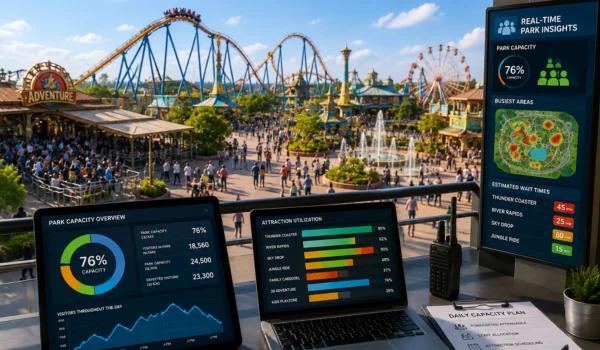
Adventure park capacity can be understood at several different levels.
- Physical Capacity
The number of people who can physically occupy the park or a particular zone.
- Activity Capacity
The number of people a specific activity can accommodate over a particular period.
- Operational Capacity
The number of visitors the staff, ticketing, food service, maintenance and other systems can handle.
- Comfortable Capacity
The number of visitors the park can accommodate without excessive crowding, uncomfortable queues or a poor customer experience.
- Emergency Capacity
The number of visitors that can be safely managed considering emergency access, evacuation and rescue requirements.
For a commercial adventure park, the practical operating limit should be based on the real bottlenecks, not simply the largest theoretical number.
Why Capacity Planning Matters
Poor capacity planning can create several problems.
A park that is too small for its expected demand may experience:
- Long queues
- Crowded activity zones
- Overloaded food outlets
- Parking problems
- Visitor frustration
- Staff pressure
- Reduced safety margins
- Poor reviews
On the other hand, a park designed for far more visitors than the market can generate may have:
- Excessive infrastructure costs
- Underused attractions
- Higher maintenance expenses
- Higher staffing requirements
- Weak returns on invested capital
The goal is therefore not:
“Build the biggest possible park.”
It is:
“Build a park whose capacity matches realistic demand and operating requirements.”
Capacity vs Throughput: What’s the Difference?
These two terms are often confused.
Capacity
Capacity is the number of visitors or users that can be accommodated.
Throughput
Throughput is the number of visitors an attraction or system can process over a period of time.
For example, imagine a zipline can safely process:
10 participants per cycle
and one complete cycle takes:
10 minutes
The theoretical hourly throughput would be:
10 participants × 6 cycles = 60 participants per hour
But 60 people per hour may not be the realistic operating figure.
Loading time, unloading, equipment checks, weather interruptions, staff rotation and operational procedures can reduce actual throughput.
Therefore:
Theoretical Capacity ≠ Practical Throughput
How to Calculate Activity Throughput
A simplified formula is:
Hourly Throughput = Users Per Cycle × 60 ÷ Average Cycle Time in Minutes
Suppose a rope course allows:
12 participants per session
and each session takes:
30 minutes
Then:
12 × 60 ÷ 30 = 24 users per hour
If the activity operates for 8 hours:
24 × 8 = 192 theoretical users per day
This is only a planning example.
Actual usable capacity should account for breaks, maintenance, weather, staffing, safety procedures and other operating conditions.
The Bottleneck Determines the Real Capacity
Imagine an adventure park has:
- Entry capacity: 1,000 visitors/day
- Parking capacity: 900 vehicles/day
- Food-service capacity: 700 meals/day
- Main zipline capacity: 300 users/day
- Rope course capacity: 400 users/day
It would be misleading to simply say:
“The park has capacity for 1,000 visitors.”
If a large proportion of visitors expect to use the zipline, the zipline can become the bottleneck.
This is why capacity planning must examine the entire visitor journey, not just the entrance.
- Start With Expected Visitor Demand
Before calculating infrastructure capacity, estimate how many people are likely to visit.
Separate demand into:
- Average weekday
- Average weekend
- Peak weekend
- School holidays
- Public holidays
- Peak season
- Low season
For example, a hypothetical park might forecast:
| Period | Expected Visitors |
| Normal weekday | 150 |
| Busy weekday | 250 |
| Normal weekend day | 500 |
| Peak weekend day | 800 |
| Major holiday | 1,000 |
The park should not necessarily build its entire infrastructure around a once-a-year peak.
Instead, it should determine how peak demand can be managed without creating excessive permanent costs.
- Calculate Peak-Day Capacity
Average visitors are not enough.
A park may receive only 250 visitors on a normal weekday but 900 visitors on a major holiday.
Therefore, capacity planning should answer:
“What happens when demand is at its highest?”
Consider:
- Ticket counters
- Parking
- Entry gates
- Security
- Activity queues
- Food outlets
- Toilets
- Seating
- Emergency routes
- Staff availability
A system that works perfectly at 300 visitors may fail at 900.
- Plan Activity Capacity
Every major activity should have its own capacity calculation.
For example:
| Activity | Users/Cycle | Cycle Time | Theoretical Hourly Throughput |
| Zipline | 10 | 10 min | 60 |
| Rope Course | 12 | 30 min | 24 |
| Climbing Wall | 4 | 10 min | 24 |
| Archery | 10 | 15 min | 40 |
| Obstacle Course | 15 | 20 min | 45 |
These figures are purely illustrative.
Actual capacity must come from the equipment design, manufacturer specifications, engineering assessment, operating procedures and applicable safety requirements.
India’s adventure-tourism guidance specifically states that the manufacturer’s rated capacity of adventure-sports equipment should not be exceeded.
- Don’t Assume Every Visitor Uses Every Activity
This is an important part of capacity planning.
Suppose the park receives:
800 visitors
It does not mean all 800 will simultaneously want to use the zipline.
The operator should estimate the participation rate.
For example:
- 70% may try general activities
- 40% may choose the zipline
- 25% may choose the rope course
- 15% may choose climbing
- 30% may purchase another paid activity
These percentages are hypothetical and should be replaced with actual customer data as the park operates.
This approach helps prevent overbuilding every attraction.
- Calculate Simultaneous Capacity
A park needs to understand not only daily visitors but also how many people may be inside an activity at the same time.
For example:
A rope course might accommodate 12 people per session.
If three sessions are operating simultaneously:
12 × 3 = 36 participants
But the surrounding area must also accommodate:
- Waiting visitors
- Instructors
- Staff
- Observers
- Entry/exit movement
- Safety zones
Therefore, activity capacity and zone capacity must be planned together.
- Queue Capacity Is Part of Park Capacity
Queues are not simply empty space between visitors.
They need:
- Adequate width
- Safe circulation
- Shade where appropriate
- Clear instructions
- Controlled entry
- Staff visibility
- Emergency access
If an activity can process 100 visitors per hour but only has enough queue space for 30 people, the remaining visitors may spill into public circulation areas.
That creates an operational bottleneck.
Therefore:
Activity Capacity + Queue Capacity + Circulation Capacity
must work together.
- Visitor Flow Matters
Visitors should be able to move logically through the park.
A simplified journey may look like:
Parking → Entrance → Orientation → Activity Zone → Food → Secondary Activities → Rest Area → Exit
If thousands of visitors repeatedly cross the same narrow area, congestion can occur even when the total park area is large.
Good capacity planning therefore considers:
- Pathways
- Activity entrances
- Exit routes
- Queue locations
- Food outlets
- Toilets
- Seating
- Viewing areas
Professional park-planning practice treats visitor flow and attraction throughput as connected planning variables rather than separate issues.
- Food & Beverage Capacity
Food service is another potential bottleneck.
Suppose:
800 visitors
arrive during a peak period, but the park’s food operation can comfortably serve only 200 meals per hour.
The result could be:
- Long queues
- Lost sales
- Customer dissatisfaction
- Crowded seating
- Staff pressure
Capacity planning should therefore estimate:
Expected food purchasers × Average transaction time × Peak demand
The exact model will vary depending on whether the park uses a café, food court, kiosks, quick-service counters or multiple outlets.
- Toilet Capacity Should Be Planned Alongside Visitor Capacity
Toilets are not an exciting part of adventure park planning, but they are essential infrastructure.
The number, location and servicing requirements should correspond to:
- Peak visitor load
- Park layout
- Activity zones
- Food areas
- Family areas
- Staff requirements
A park can have excellent attractions but still receive negative feedback if basic visitor infrastructure cannot handle peak demand.
- Parking Capacity
Parking is another major capacity constraint.
Suppose a park expects:
700 visitors
That does not necessarily mean 700 cars.
Some visitors may arrive:
- As families
- In groups
- By school buses
- Through corporate buses
- By taxis
- On two-wheelers
Therefore, parking capacity should be calculated using the expected transport mix.
For school and corporate groups, coach/bus movement should be considered separately from normal car parking.
- Staff Capacity Matters
An attraction may have enough physical capacity but insufficient trained staff.
Staff requirements can include:
- Activity instructors
- Safety personnel
- Ticketing staff
- Security
- First-aid/medical support
- Food-service staff
- Housekeeping
- Maintenance
- Customer service
- Supervisors
Adventure tourism safety frameworks emphasise trained and certified personnel, equipment inspection, SOPs and emergency response planning.
Therefore, staffing capacity is part of the park’s operational capacity.
- Safety Capacity Must Come Before Revenue Capacity
An operator should never increase visitor numbers merely because additional visitors could generate more revenue.
For example, if an activity is safely designed for a certain number of participants, selling additional slots to increase revenue would be inappropriate.
Capacity planning should therefore follow this order:
Safety → Equipment Limits → Staff Capacity → Visitor Flow → Commercial Capacity
not:
Revenue Target → More Tickets → Figure Out Safety Later
The Ministry of Tourism has also asked States and UTs to maintain strict oversight of adventure activities and ensure adherence to safety regulations and licensing norms.
- Use a Practical Capacity Factor
Theoretical capacity should not automatically become the advertised daily capacity.
A useful planning approach is to apply an internal operating factor.
For example:
Practical Capacity = Theoretical Capacity × Operating Factor
If theoretical capacity is:
1,000 visitors/day
and an internal planning factor of 75% is used:
1,000 × 75% = 750 visitors/day
The 75% figure here is only illustrative.
The appropriate factor depends on:
- Activity mix
- Queue design
- Staff levels
- Park layout
- Weather
- Maintenance
- Customer experience objectives
- Safety requirements
- Capacity Affects Revenue Potential
Capacity directly influences revenue potential.
Suppose:
Practical daily capacity = 700 visitors
Average revenue per visitor = ₹800
Then simplified maximum daily revenue potential would be:
700 × ₹800 = ₹5.6 lakh
If the park operates 25 days per month at that level:
₹5.6 lakh × 25 = ₹1.4 crore
This is a hypothetical gross-revenue illustration, not a business forecast.
Actual revenue depends on occupancy, seasonality, ticket pricing, discounts, add-on spending, closures, operating days and many other factors.
- Capacity Utilisation Is More Useful Than Maximum Capacity
A park may have a theoretical capacity of:
1,000 visitors/day
but average only:
500 visitors/day
Its average capacity utilisation is:
500 ÷ 1,000 × 100 = 50%
This tells the operator something important.
The park may have significant unused capacity.
Instead of immediately adding more attractions, the operator might focus on:
- Weekday promotions
- Corporate bookings
- School groups
- Events
- Memberships
- Better marketing
- Seasonal packages
In other words:
Low utilisation may be a demand problem, not a capacity problem.
- Don’t Build Capacity That the Market Cannot Support
Suppose market research suggests that realistic demand is:
400 visitors/day
but the park is designed for:
1,500 visitors/day
The additional infrastructure may sit underutilised for much of the year.
That can increase:
- Capital investment
- Maintenance
- Staffing
- Utilities
- Cleaning
- Security
- Insurance and operating complexity
A smaller, efficiently utilised park can sometimes be commercially stronger than a huge underutilised facility.
- Plan for Peak Demand Without Overbuilding
There are several ways to manage peak periods.
Instead of permanently building enough infrastructure for extreme peaks, operators can consider:
- Timed entry
- Advance reservations
- Activity time slots
- Group scheduling
- Online booking
- Peak-day pricing
- Visitor caps
- Additional temporary staffing where appropriate
- Staggered school/corporate bookings
The correct solution depends on the park’s design and applicable safety requirements.
- Capacity Planning Can Improve Revenue
Capacity planning is not only about avoiding overcrowding.
It can also improve revenue.
For example, if visitors spend less time waiting and more time participating in activities, the park may have more opportunities for:
- Additional activity purchases
- Food purchases
- Merchandise
- Photography
- Events
- Repeat visits
A smoother visitor journey can therefore support both customer satisfaction and commercial performance.
- Use Revenue Per Available Capacity
One useful management concept is to connect revenue with the park’s available capacity.
A simplified metric could be:
Revenue Per Available Visitor Capacity = Revenue ÷ Available Capacity
For example:
Monthly revenue:
₹80 lakh
Available visitor capacity:
40,000 visitor slots
Then:
₹80,00,000 ÷ 40,000 = ₹200 per available capacity slot
This can help compare how effectively the park is monetising its available capacity.
However, operators should not use such a metric in isolation. Actual utilisation, costs, seasonality and customer experience also matter.
- Capacity Planning for Different Park Sizes
A useful way to think about capacity is by park concept rather than only land size.
Small Adventure Park
May focus on:
- Limited activities
- Local families
- Schools
- Resorts
- Short-duration visits
The priority is efficient use of limited space.
Mid-Size Adventure Park
May combine:
- Multiple activity zones
- Food and beverage
- Group bookings
- Family visitors
- Corporate events
Here, visitor flow becomes increasingly important.
Large Destination Adventure Park
May include:
- Multiple adventure zones
- Large parking
- Food courts
- Events
- Accommodation or camping
- Retail
- Large group facilities
At this level, capacity modelling becomes much more complex because multiple systems interact.
Example: A Hypothetical Capacity Model
Imagine an adventure park with the following planning assumptions:
- Practical daily visitor capacity: 800
- Average ticket revenue: ₹600
- Average additional spending: ₹250
- Average total revenue per visitor: ₹850
If the park reaches 60% of its practical capacity:
800 × 60% = 480 visitors/day
Estimated daily revenue:
480 × ₹850 = ₹4.08 lakh
At 26 operating days:
₹4.08 lakh × 26 = ₹106.08 lakh
or approximately:
₹1.06 crore monthly gross revenue
Again, this is purely a hypothetical calculation.
It does not account for operating costs, taxes, discounts, closures, seasonality, financing or other expenses.
A Capacity Planning Checklist
Before opening an adventure park, evaluate:
Visitor Demand
- Expected average visitors
- Peak-day visitors
- Seasonal demand
- School/corporate demand
- Repeat visitors
Activities
- Capacity of each activity
- Cycle time
- Loading/unloading time
- Safety checks
- Instructor availability
- Equipment limits
Visitor Flow
- Entry capacity
- Queue capacity
- Pathway capacity
- Activity circulation
- Exit capacity
Infrastructure
- Parking
- Toilets
- Food service
- Drinking water
- Seating
- Shade
- Waste management
Operations
- Staff
- Maintenance
- Ticketing
- Customer service
- Security
- Emergency response
Commercial
- Ticket price
- Revenue per visitor
- Capacity utilisation
- Peak-day revenue
- Add-on spending
- Group bookings
Common Capacity Planning Mistakes
Mistake 1: Treating Land Area as Visitor Capacity
A large property does not automatically mean large operational capacity.
Mistake 2: Using Manufacturer Capacity as Daily Park Capacity
Equipment capacity and total park capacity are different concepts.
Mistake 3: Ignoring Queues
An attraction may have excellent throughput but poor queue infrastructure.
Mistake 4: Ignoring Staff Capacity
Equipment cannot operate safely without adequate trained personnel.
Mistake 5: Designing Only for Average Days
Peak demand is where operational problems usually become visible.
Mistake 6: Overbuilding
More capacity is not always better if the market cannot support it.
Mistake 7: Chasing Revenue at the Expense of Safety
Capacity should never exceed applicable equipment, operational or safety limits.
Final Takeaway
Adventure park capacity planning is essentially the process of answering four questions:
How many visitors can we attract?
How many can we safely handle?
How quickly can our activities serve them?
How much revenue can that capacity realistically generate?
The answer requires more than calculating land area.
A commercially sensible capacity model connects:
Demand + Activity Throughput + Visitor Flow + Staff + Infrastructure + Safety + Revenue
The strongest adventure parks are not necessarily those that accommodate the largest crowds.
They are the ones that can serve the right number of visitors efficiently, safely and comfortably while generating healthy revenue from their available capacity.
That is why capacity planning should happen before the final park layout, activity mix and infrastructure investment are locked in.