Corporate team building is no longer limited to conference rooms, presentations and indoor workshops. Many companies are using outdoor experiences to help employees interact differently, solve problems together and build stronger workplace relationships.
An adventure park for corporate team building can combine recreation with structured challenges such as rope courses, obstacle challenges, paintball, archery, climbing and team games.
The idea is not simply to make employees participate in extreme activities. A well-designed corporate adventure programme should match the company’s objectives, employee comfort levels, group size and safety requirements.
India’s Ministry of Tourism has identified skills, capacity building and safety management as important pillars of adventure tourism, while its safety framework emphasises risk management, trained personnel, equipment standards and emergency planning.
What Is Adventure-Based Corporate Team Building?
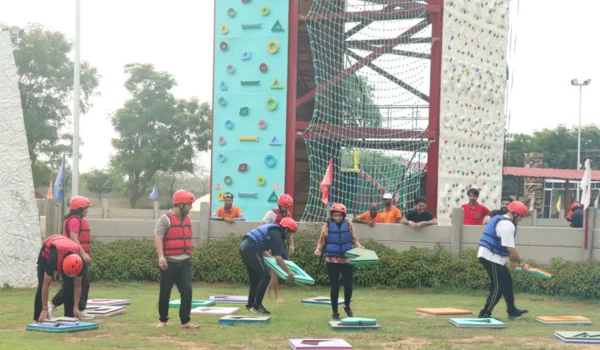
Adventure-based team building uses outdoor activities and challenges to encourage employees to work together.
Instead of discussing teamwork theoretically, employees experience situations where they may need to:
- Communicate clearly
- Divide responsibilities
- Trust teammates
- Make decisions
- Solve problems
- Manage time
- Support colleagues
- Adapt to changing situations
The activity itself is only one part of the experience. The way it is organised and facilitated determines how useful it becomes for the team.
Why Choose an Adventure Park for a Corporate Outing?
An adventure park can take employees outside their normal workplace environment.
This change can create opportunities for informal interaction between:
- Different departments
- Managers and employees
- New and experienced employees
- Remote and office-based teams
- Senior and junior staff
Corporate adventure destinations in India already offer programmes built around team building, leadership, employee engagement and corporate training. For example, Della Adventure describes dedicated corporate programmes including team-building and leadership-oriented activities.
Best Adventure Park Activities for Corporate Teams
Not every adventure activity is suitable for every company. The best programme usually combines several activities with different physical and mental requirements.
- Obstacle Courses
Obstacle courses can include:
- Walls
- Nets
- Balance elements
- Crawling sections
- Hurdles
- Team challenges
They can encourage communication, planning and coordination.
Instead of allowing only the fastest employee to finish, a team-oriented obstacle course can be structured so that members need to support each other.
Best for: teamwork, coordination and problem-solving.
- Rope Courses
Rope courses are popular corporate adventure activities.
Participants may have to navigate elevated or ground-level rope elements while following safety instructions.
Depending on the design, activities can encourage:
- Trust
- Communication
- Confidence
- Decision-making
- Mutual support
For corporate groups, the course should be selected according to employee fitness, experience and comfort with heights.
- Ziplining
Ziplining is usually more recreational than strategic, but it can still be valuable as part of a broader corporate outing.
It can provide:
- Excitement
- Confidence-building
- A shared experience
- A break from routine
However, a zipline by itself should not be described as a complete team-building exercise.
It works better when combined with group challenges or facilitated activities.
- Team Obstacle Challenges
A team obstacle challenge can be specifically designed around collaboration.
For example:
Challenge → Strategy → Team roles → Execution → Review
Employees may discover that completing the task quickly is less important than coordinating effectively.
This type of activity can be particularly useful for teams that need better communication.
- Paintball
Paintball can introduce elements of:
- Strategy
- Leadership
- Communication
- Team coordination
- Decision-making
Teams may have to develop a plan, assign roles and respond to changing situations.
However, the activity should be optional and appropriately managed because employees have different physical abilities and comfort levels.
- Archery
Archery can be used as a lower-intensity competitive activity.
Companies can organise:
- Individual challenges
- Team scoring
- Friendly competitions
- Accuracy contests
It can provide variety when a programme contains several physically demanding activities.
- Rock Climbing
Rock climbing can provide an individual challenge within a group environment.
Team members can encourage one another while participants attempt the activity.
It can be useful for:
- Confidence
- Encouragement
- Support
- Goal-setting
The activity should always be conducted using appropriate equipment and trained personnel.
- Treasure Hunts
Treasure hunts are particularly useful when the company wants a team-building activity that is less physically demanding.
Teams may need to:
- Decode clues
- Find locations
- Divide responsibilities
- Communicate information
- Make decisions
This makes treasure hunts suitable for mixed-age and mixed-fitness corporate groups.
- Problem-Solving Challenges
Not every corporate activity needs to involve heights or adrenaline.
Adventure parks can also use:
- Puzzle challenges
- Construction tasks
- Team strategy games
- Navigation activities
- Time-based challenges
These can help employees practise collaboration without requiring high physical effort.
- Multi-Activity Team Challenge
For a corporate group, a combination of activities can often work better than one large challenge.
For example:
Round 1: Ice-breaker
Round 2: Team puzzle
Round 3: Obstacle challenge
Round 4: Archery
Round 5: Rope activity
Round 6: Team reflection
This gives employees different ways to contribute.
Key Benefits of Adventure Park Team Building
- Better Communication
Outdoor challenges can create situations where employees need to communicate clearly and quickly.
A team may need to decide:
- Who does what?
- Which strategy should be used?
- Who needs assistance?
- How should the available time be managed?
The Ministry of Tourism’s Panchkula destination planning documentation specifically describes adventure-park team-building programmes as supporting teamwork, communication and leadership skills.
- Stronger Team Bonding
Shared experiences can give employees something to discuss beyond their normal work responsibilities.
Completing a difficult challenge together can create a common memory.
This can be particularly useful for teams that rarely interact outside formal meetings.
- Trust Building
Some activities require participants to rely on instructions, coordination and support from colleagues.
Trust-building exercises should never involve forcing employees into activities they are uncomfortable with.
The objective should be voluntary participation and constructive teamwork, not fear.
- Leadership Development
Adventure challenges can reveal different leadership behaviours.
One employee may naturally:
- Organise the group
- Encourage others
- Analyse the problem
- Take responsibility
- Communicate instructions
Another employee may be better at execution or supporting teammates.
Structured programmes can use these situations for leadership discussions.
Corporate adventure providers in India commonly position such programmes around leadership, communication and interpersonal development.
- Problem-Solving Skills
Many team challenges do not have an obvious solution.
Employees may have to:
Understand → Plan → Test → Adjust → Complete
This can create an opportunity to observe how teams behave when facing unfamiliar problems.
- Employee Engagement
A well-planned adventure outing can provide a break from routine work.
Employees may appreciate:
- Outdoor time
- Recreation
- Social interaction
- Friendly competition
- New experiences
The value is not simply entertainment; it is also the opportunity to create a shared employee experience.
- Cross-Department Interaction
A corporate adventure programme can intentionally mix employees from different departments.
For example:
HR + Sales + Finance + Operations + IT
Instead of remaining within departmental groups, employees can work together on a common challenge.
This can improve informal familiarity and reduce organisational silos.
Adventure Activities Should Not Be Forced
One of the most important principles of corporate adventure programmes is inclusion.
Employees can have different:
- Fitness levels
- Ages
- Medical considerations
- Physical abilities
- Comfort with heights
- Adventure experience
Therefore, companies should not design the entire programme around extreme activities.
A better approach is to provide multiple participation options.
High intensity
- Advanced obstacle course
- High ropes
- Paintball
Moderate intensity
- Rope challenges
- Archery
- Team obstacle activities
Low intensity
- Treasure hunt
- Strategy games
- Team puzzles
- Nature-based activities
This allows more employees to participate meaningfully.
Safety Should Come Before Team Building
Adventure should never be treated as a substitute for safety.
The Ministry of Tourism’s national safety framework emphasises risk management, appropriate equipment, trained instructors, inspection and certification, communication procedures, incident analysis and emergency response planning.
In 2025, the Ministry also stated that Model Adventure Safety Guidelines had been circulated to States and Union Territories for adoption or updating of safety protocols, with States/UTs asked to maintain oversight and adherence to applicable safety and licensing requirements.
Before booking, a company should ask the park about:
- Activity-specific safety procedures
- Instructor qualifications
- Equipment inspection
- Emergency response
- First-aid arrangements
- Participant restrictions
- Weather protocols
- Insurance and applicable permissions
- Emergency access
Exact requirements can vary by activity, operator and applicable State/UT rules.
How to Plan a Corporate Adventure Day
A simple corporate programme might look like this:
| Time | Activity |
| 9:30 AM | Arrival & registration |
| 10:00 AM | Welcome and safety briefing |
| 10:30 AM | Ice-breaker activity |
| 11:00 AM | Team challenge |
| 12:00 PM | Adventure activity |
| 1:00 PM | Lunch |
| 2:00 PM | Problem-solving challenge |
| 3:00 PM | Outdoor competition |
| 4:00 PM | Refreshments |
| 4:30 PM | Team reflection |
| 5:00 PM | Closing |
The exact schedule should be adjusted according to the park, weather, group size, travel time and activity capacity.
How to Choose the Right Adventure Park for a Corporate Team
Before selecting a venue, HR or administration teams should consider:
- Group Size
Can the park comfortably handle your entire team?
- Activity Variety
Are there activities for different fitness and comfort levels?
- Safety
Does the park have clear safety procedures and trained staff?
- Location
How long will employees spend travelling?
- Food and Facilities
Check:
- Dining
- Drinking water
- Toilets
- Changing areas
- Rest areas
- Parking
- Weather
Outdoor programmes need contingency plans for extreme heat, rain or other unsuitable conditions.
- Professional Facilitation
If the objective is genuine team development rather than simply entertainment, consider a trained facilitator.
Adventure Park vs Traditional Corporate Outing
| Factor | Adventure Park | Traditional Outing |
| Team interaction | High potential | Variable |
| Physical activity | Usually higher | Usually lower |
| Problem-solving | Can be structured | Often limited |
| Entertainment | High | High |
| Team challenges | Strong | May be limited |
| Leadership exercises | Possible | Depends on programme |
| Employee participation | Activity-dependent | Usually easier |
| Safety planning | More important | Generally simpler |
The key difference is intentional design.
Simply taking employees to an adventure park does not automatically create team building.
The activities need to be connected to the company’s objective.
How to Make Adventure Team Building More Effective
Companies can improve the experience by following a simple model:
Before the Event
Identify the objective.
For example:
Communication → Choose communication challenges
Leadership → Choose leadership-oriented activities
Employee bonding → Choose collaborative and recreational activities
During the Event
Create mixed teams.
Avoid allowing departments to remain isolated.
After the Activity
Conduct a short discussion.
Ask:
- What worked?
- What didn’t?
- Who took leadership?
- How did the team solve the problem?
- What can we apply at work?
This final reflection can turn an enjoyable outing into a more meaningful team-development experience.
Common Mistakes Companies Should Avoid
Choosing activities only for thrill
High adrenaline does not automatically mean better team building.
Ignoring employee comfort
Not everyone enjoys heights, speed or physically demanding activities.
Packing too many activities
A rushed schedule can reduce enjoyment and increase fatigue.
Ignoring travel time
A long journey can consume much of the day.
Skipping safety checks
The venue should be evaluated before the booking is confirmed.
Making everything competitive
Competition can be fun, but excessive competition may exclude less-confident employees.
Forgetting downtime
Employees also need time to eat, relax and interact informally.
Final Takeaway
An adventure park can be an effective setting for corporate team building when activities are selected around a clear objective.
Activities such as obstacle courses, rope challenges, paintball, archery, climbing, treasure hunts and team problem-solving games can encourage communication, collaboration, confidence and leadership.
But the best corporate adventure programme is not necessarily the most extreme one.
It is the one that provides the right balance of:
Adventure + Safety + Inclusion + Teamwork + Fun
For HR teams, the goal should be to create an experience where employees return to work with stronger connections, better understanding of colleagues and positive shared memories—not simply a collection of adrenaline-filled activities.