When planning an adventure park business, one of the first strategic decisions is whether to operate indoors or outdoors.
The two models can offer very different business economics.
An indoor adventure park can operate inside a mall, warehouse, commercial building or purpose-built facility. It can provide greater protection from weather and can work particularly well in dense urban markets.
An outdoor adventure park, on the other hand, can use large open spaces, natural terrain, height differences, trees and other environmental features to create experiences that are difficult to reproduce indoors.
There is no universally better model.
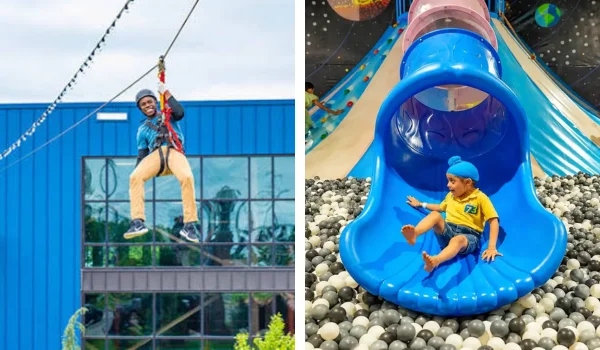
The right choice depends on:
- Location
- Land or rental cost
- Climate
- Target customers
- Activity mix
- Investment capacity
- Visitor capacity
- Seasonality
- Parking
- Operating costs
- Expansion plans
Industry sources in India similarly distinguish the models by location, climate, land availability and customer profile: indoor parks are generally suited to urban markets and controlled environments, while outdoor parks can benefit from open land and natural terrain.
What Is an Indoor Adventure Park?
An indoor adventure park operates inside a controlled building or enclosed commercial space.
Common activities can include:
- Trampoline zones
- Climbing walls
- Indoor rope courses
- Ninja/obstacle courses
- Soft-play adventure areas
- Foam pits
- Indoor challenge zones
- Interactive games
- Adventure-themed attractions
A major advantage is environmental control.
The operator can potentially provide a more consistent experience regardless of rain, extreme heat or other outdoor weather conditions.
For example, a large indoor adventure venue in India can combine trampolines, climbing and multiple activity zones under one roof.
What Is an Outdoor Adventure Park?
An outdoor adventure park operates in an open environment.
Typical activities may include:
- Zipline
- High-rope course
- Obstacle course
- Giant swing
- Climbing
- Archery
- Outdoor challenges
- Adventure trails
- Nature activities
- Camping
- Team-building activities
Outdoor parks have an important advantage: space.
A suitable property can use natural terrain and landscape as part of the attraction rather than having to recreate everything inside a building.
Indoor vs Outdoor: Basic Comparison
| Factor | Indoor Adventure Park | Outdoor Adventure Park |
| Location | Urban/commercial areas | Open land/tourism areas |
| Weather impact | Lower | Higher |
| Land requirement | Lower | Generally higher |
| Rent | Can be high | Land cost varies |
| Natural terrain | Limited | Major advantage |
| High-thrill outdoor activities | Limited | Strong potential |
| Climate control | Possible | Not applicable |
| Parking requirement | Depends on site | Usually significant |
| Seasonality | Generally lower | Usually higher |
| Urban accessibility | Often strong | Depends on location |
| Expansion | Building-dependent | Land-dependent |
| Tourism potential | Moderate to high | Often stronger |
| Family market | Strong | Strong |
| Corporate use | Strong | Strong |
| School trips | Strong | Strong |
The table provides a strategic comparison rather than a universal cost or performance benchmark.
Indoor Adventure Park Business
- Location Can Be a Major Advantage
Indoor parks can operate closer to concentrated urban populations.
Potential locations include:
- Shopping malls
- Commercial complexes
- Entertainment centres
- Large warehouses
- Mixed-use developments
This can reduce travel time for customers.
The trade-off is that prime urban space can involve substantial rent or property costs.
- Weather Protection
An indoor facility can potentially operate through:
- Summer heat
- Monsoon rain
- Winter conditions
- Short-term weather disruptions
This can make revenue planning more predictable than an outdoor operation that depends heavily on weather.
However, indoor parks still have operational risks such as power interruptions, HVAC requirements and building-related maintenance.
- Smaller Physical Footprint
An indoor park can make intensive use of vertical space.
For example, a building with sufficient ceiling height can accommodate multi-level activities.
This means an indoor model may be attractive where:
Land is expensive but customer density is high.
However, the available floor area, ceiling height, structural capacity, circulation and emergency exits must be evaluated before selecting the property.
- Strong Family and Kids Market
Indoor adventure parks can work particularly well for:
- Children
- Teenagers
- Families
- Birthday parties
- Weekend entertainment
They can also combine activities such as trampoline areas, soft play, climbing and obstacle courses.
This multi-activity format can increase the number of customer segments served by one facility.
- Corporate and School Opportunities
Indoor parks can also sell:
- Corporate team-building
- School visits
- Birthday events
- Private parties
- Group packages
This can diversify revenue beyond walk-in customers.
- Indoor Operating Costs
The major challenge is that an indoor park depends heavily on the building.
Potential costs include:
- Rent or property cost
- HVAC
- Electricity
- Interior construction
- Fire-safety infrastructure
- Building maintenance
- Lighting
- Ventilation
- Equipment maintenance
Therefore, lower land requirements do not automatically mean lower total operating costs.
Outdoor Adventure Park Business
- Natural Environment Becomes Part of the Product
An outdoor park can use its surroundings as an attraction.
A forest-like environment, hill, valley, lake or large open landscape can add experiential value.
This can help differentiate the park from indoor entertainment centres.
- More Scope for High-Thrill Activities
Outdoor environments are generally better suited to attractions that need significant height, length or open space.
Examples include:
- Long ziplines
- High ropes
- Giant swings
- Large obstacle courses
- Adventure trails
The exact activity should always be selected according to engineering, safety, site and regulatory requirements.
- Tourism Potential
An outdoor adventure park can become part of a destination rather than merely a local entertainment venue.
For example:
Tourist destination + Adventure Park + Resort + Food
can create a broader tourism ecosystem.
The Ministry of Tourism’s National Strategy for Adventure Tourism includes destination and product development as one of its strategic pillars.
- More Land, More Possibilities
Outdoor parks generally have greater scope for future expansion if sufficient land is available.
An operator could initially build:
Phase 1 → Rope course + Zipline + Kids zone
and later add:
Phase 2 → Camping + Events + New adventure activities
This can be easier than expanding an indoor facility when the existing building is already at maximum capacity.
- Weather Is a Major Business Variable
The biggest challenge is weather.
Heavy rain, extreme heat, strong winds or other conditions can affect:
- Visitor numbers
- Activity operations
- Safety
- Staff productivity
- Equipment
- Maintenance
Therefore, an outdoor park should have a weather-management strategy.
Possible measures include:
- Covered waiting areas
- Shaded zones
- Weather monitoring
- Flexible bookings
- Alternative activities
- Seasonal programming
Activities should be suspended whenever conditions make safe operation unsuitable.
Which Model Requires More Investment?
There is no universal answer.
The cost structure is simply different.
Indoor Model
Major investment may go into:
- Building/rent deposit
- Interior fit-out
- Equipment
- HVAC
- Fire and life-safety systems
- Electrical infrastructure
- Flooring
- Lighting
- Branding
Outdoor Model
Major investment may go into:
- Land
- Civil works
- Foundations
- Adventure structures
- Trails
- Parking
- Drainage
- Utilities
- Landscaping
- Safety infrastructure
Commercial industry sources also note that adventure-park setup costs vary substantially depending on site conditions, activity mix, civil work, safety infrastructure and finish quality, so simple indoor-versus-outdoor cost comparisons can be misleading.
Rent vs Land Ownership
This is one of the biggest strategic differences.
An indoor operator may lease a property.
For example:
Monthly Rent × 12 = Annual Occupancy Cost
An outdoor operator may purchase or lease land.
Therefore, the financial decision becomes:
High Urban Rent vs Larger Land Requirement
An indoor park can make sense when high population density generates enough customer traffic to justify rent.
An outdoor park can make more sense when land is available at a suitable cost and the destination has sufficient demand.
Revenue Potential: Indoor vs Outdoor
Both models can generate multiple revenue streams.
Indoor
Potential revenue sources include:
- Entry tickets
- Timed sessions
- Memberships
- Birthday parties
- School groups
- Corporate events
- Food and beverages
- Merchandise
- Premium activities
Outdoor
Potential revenue sources include:
- Entry tickets
- Adventure activity charges
- Group packages
- School trips
- Corporate events
- Food and beverages
- Camping
- Accommodation
- Photography
- Merchandise
- Events
Outdoor parks may have greater potential to combine adventure with tourism and accommodation where the site supports it.
Which Has Better Revenue Per Square Foot?
This question is more complicated than it appears.
Indoor parks can generate substantial activity density within a relatively compact area.
Outdoor parks can use large areas but may have lower revenue density per square foot.
However, outdoor land can potentially support attractions that generate higher-value experiences.
Therefore, instead of simply asking:
“Which generates more revenue per square foot?”
the operator should evaluate:
Revenue − Operating Costs − Occupancy Costs
and then calculate the return on invested capital.
Customer Catchment Matters More Than the Format
Imagine two properties.
Property A
Indoor park:
- 15,000 sq ft
- Dense urban catchment
- High rent
- Strong weekend traffic
- Limited parking
Property B
Outdoor park:
- 5 acres
- Lower land cost
- 40 km from the city
- Large parking area
- Tourism potential
- Lower weekday local traffic
Neither is automatically better.
Property A may win because of frequency and accessibility.
Property B may win because of destination appeal and larger experiences.
The business model should therefore start with the customer market, not the attraction itself.
Indoor Parks Are Often Better for Urban Catchments
An indoor model can be attractive when:
- Population density is high
- Land is expensive
- Customers prefer short travel times
- Mall/commercial footfall is strong
- Families are the primary audience
- Weather makes outdoor operations difficult
- Birthday and group events are important
The model becomes:
Urban Location → Frequent Visits → Memberships → Events → Repeat Revenue
Outdoor Parks Are Often Better for Destination Experiences
An outdoor model can be attractive when:
- Land is available
- Natural terrain is valuable
- Tourism is strong
- Customers accept longer travel
- Weekend trips are common
- Corporate retreats are possible
- Accommodation can be added
The model becomes:
Destination → Adventure → Food → Events → Accommodation → Longer Customer Stay
Safety Applies to Both Models
Indoor does not mean automatically safe.
Outdoor does not mean automatically unsafe.
Both require:
- Proper equipment
- Appropriate design
- Trained staff
- Operating procedures
- Inspections
- Emergency planning
- Maintenance
- Participant briefing
- Activity-specific risk management
India’s National Adventure Tourism Safety Management Framework calls for measures including equipment standards, standard operating procedures, inspection/certification, trained personnel, risk management, incident recording and emergency response planning.
In March 2026, the Ministry of Tourism stated that Model Adventure Safety Guidelines had been circulated to States and Union Territories for adoption/updating and that States/UTs had been asked to ensure adherence to applicable safety regulations and licensing norms.
So the correct business question is not:
“Which format is safer?”
It is:
“Which format can I operate safely and compliantly at the required scale?”
Indoor vs Outdoor: Seasonality
Seasonality can significantly affect the business.
Indoor
Revenue may be relatively more stable because the attraction is protected from outdoor weather.
Outdoor
Demand may vary according to:
- Summer
- Monsoon
- Winter
- School holidays
- Tourism seasons
However, outdoor parks can also create seasonal experiences that become a marketing advantage.
Hybrid Adventure Park: The Third Option
The choice does not always have to be 100% indoor or 100% outdoor.
A hybrid model can combine:
Indoor Adventure Zone + Outdoor Adventure Zone
For example:
Indoor
- Climbing wall
- Trampoline
- Kids zone
- Ninja course
Outdoor
- Zipline
- Rope course
- Archery
- Obstacle course
- Nature trail
This can provide greater weather resilience while preserving the experiential benefits of outdoor activities.
Industry operators in India also describe hybrid combinations of indoor soft-play/climbing and outdoor adventure zones as a practical approach for resorts and other destinations.
How to Decide Which Model Is Better
Use the following decision framework.
| Question | Indoor Favoured | Outdoor Favoured |
| Is land expensive? | Yes | No |
| Is population density high? | Yes | Not essential |
| Is urban accessibility critical? | Yes | Less critical |
| Is natural terrain valuable? | No | Yes |
| Are long ziplines planned? | Difficult | Yes |
| Is weather a major concern? | Yes | No |
| Is tourism important? | Moderate | Strong |
| Are memberships important? | Strong | Moderate |
| Are accommodation packages planned? | Difficult | Strong |
| Is large parking available? | Variable | Easier |
| Is high rent acceptable? | Potentially | Usually less relevant |
| Is future land expansion available? | Limited | Potentially strong |
Five Questions Before Choosing
Before committing to either model, answer these five questions.
- Who Is Your Main Customer?
Families, children, tourists, corporates and schools may require different formats.
- Where Will Customers Come From?
Calculate the realistic catchment area and travel time.
- What Activities Will Define the Park?
A trampoline-heavy concept naturally points toward indoor space.
A zipline and high-rope concept generally requires outdoor conditions.
- What Is the Real Occupancy Cost?
Compare:
Rent + utilities + maintenance
with:
Land + infrastructure + maintenance
- What Can the Site Support Safely?
The site should determine the activity mix—not the other way around.
Practical Business Examples
Example 1: Delhi NCR Urban Market
An indoor adventure centre inside a large commercial property could target:
- Families
- Kids
- Teenagers
- Birthday parties
- Schools
- Corporate groups
The major commercial challenge would likely be occupancy cost and maintaining enough footfall.
Example 2: Tourist Destination
An outdoor adventure park near a tourism destination could combine:
- Adventure activities
- Food
- Nature
- Camping
- Accommodation
- Corporate retreats
The major challenge would be seasonality and accessibility.
Example 3: Resort Conversion
An existing resort could create:
Indoor kids/adventure zone + Outdoor adventure activities
This hybrid approach can increase the property’s overall experience offering without abandoning its existing accommodation business.
Common Mistakes
Mistake 1: Choosing Indoor Because It Needs Less Land
Less land does not automatically mean lower total cost.
Mistake 2: Choosing Outdoor Because Land Is Cheap
Cheap land is useless if customers are unwilling to travel to it.
Mistake 3: Ignoring Parking
A park can have excellent activities and still struggle if visitors cannot park conveniently.
Mistake 4: Ignoring Weather
Outdoor operators must incorporate weather into operations and financial planning.
Mistake 5: Comparing Only Ticket Prices
The real business economics include:
Ticket + Add-ons + Food + Events + Memberships − Operating Costs
Mistake 6: Installing Activities Before Understanding Demand
The activity mix should be based on customer demand, site suitability and capacity.
Final Verdict: Which Model Is Better?
There is no single winner.
Choose an Indoor Adventure Park if:
- You want an urban location
- Land is expensive
- Family and kids are your core customers
- Year-round operation is important
- You can secure sufficient footfall
- You have a suitable building with appropriate structural and safety characteristics
Choose an Outdoor Adventure Park if:
- You have access to suitable land
- Natural terrain adds value
- Tourism or weekend travel is strong
- You want high-rope or large-scale outdoor activities
- You have expansion potential
- You can manage weather-related seasonality
Choose a Hybrid Model if:
You want to combine urban/family entertainment with outdoor adventure and the property allows both.
Ultimately, the better business model is the one that matches customer demand, location economics, activity requirements, capacity and operating realities.
The decision should therefore be:
Market → Location → Customer → Activities → Capacity → Investment → Safety → Business Model
—not simply:
Indoor vs Outdoor.
For many urban markets, indoor adventure can provide the advantage of accessibility and more consistent operations. For destination-oriented properties, outdoor adventure can create a stronger experiential proposition. The right choice is the one that produces sustainable returns while allowing the park to operate safely and efficiently.