Adventure parks combine physical challenges, outdoor recreation and exciting experiences in one destination. Unlike traditional amusement parks that mainly depend on mechanical rides, adventure parks usually focus on activities involving climbing, balancing, jumping, swinging, crawling, racing and overcoming obstacles.
The exact activities available differ from one park to another. Some are designed for children and families, while others are intended for physically fit participants looking for a higher level of challenge. India’s National Strategy for Adventure Tourism distinguishes between softer adventure activities with relatively lower risk and harder activities requiring greater skills, training, fitness and expert guidance.
Here are 25+ popular adventure park activities and what visitors can expect from each.
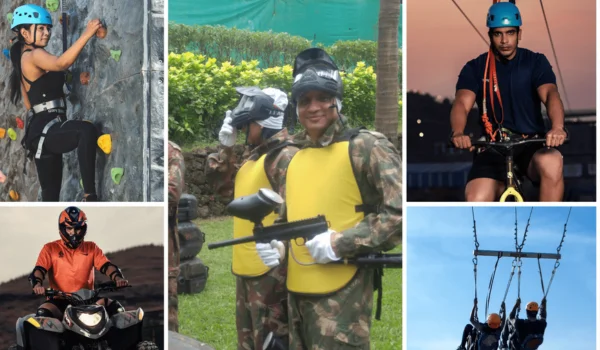
- Zipline
Ziplining is one of the most popular adventure park activities. Participants travel along a suspended cable from one platform to another, usually while wearing a safety harness.
It is relatively easy for beginners to understand and can provide an aerial experience without requiring advanced climbing skills.
Best for: Beginners, families and older children who meet the park’s requirements.
- Rope Course
A rope course consists of elevated platforms connected by different obstacles made from ropes, cables, nets and wooden elements.
Participants move from one section to another while maintaining balance and following the park’s safety system.
Experience: Balance, coordination and controlled risk.
- High-Rope Course
A high-rope course takes the traditional rope course to an elevated level. Participants may have to cross suspended bridges, ropes, platforms and other obstacles several metres above the ground.
Because height is involved, proper safety equipment, supervision and operating procedures are particularly important.
- Burma Bridge
The Burma Bridge typically consists of ropes or cables arranged as a suspended crossing.
Participants walk across while maintaining balance and using hand support.
Main challenge: Balance and concentration.
- Commando Net
A commando net is a climbing or crawling obstacle made from a large rope net.
It can be positioned horizontally, vertically or at an angle depending on the park’s design.
Best for: Kids, school groups and recreational obstacle courses.
- Rope Ladder Climbing
Rope ladders require participants to climb vertically while the ladder moves or shifts under their weight.
The activity tests coordination, grip and balance rather than simply physical strength.
- Rock Climbing
Rock climbing walls are artificial climbing structures with handholds and footholds at different positions.
Routes can be designed for beginners as well as more experienced participants.
Skills involved: Grip, balance, route planning and physical coordination.
- Wall Climbing
Wall climbing is similar to rock climbing but may use a simpler vertical climbing wall.
It is particularly common in family-oriented adventure zones and indoor adventure facilities.
- Rappelling
Rappelling involves descending vertically using ropes and appropriate safety equipment.
Unlike climbing, the primary movement is downward rather than upward.
Because rappelling involves height and technical equipment, participants generally require proper briefing and trained supervision.
- Giant Swing
A giant swing provides a larger swinging experience than an ordinary playground swing.
Participants are secured into a harness or other approved restraint system before the swing is released.
It is primarily an adrenaline-oriented experience.
- Tarzan Swing
A Tarzan swing allows participants to swing from one point toward another using a rope or cable system.
It can be incorporated into a larger aerial obstacle course or operated as an individual activity.
- Tyre Swing
Tyre swings use suspended tyres as the seating element.
They are generally more suitable for recreational and family zones than extreme adventure sections.
- Balance Beam
A balance beam challenges participants to walk across a narrow elevated or ground-level surface without falling.
The difficulty can be increased by changing the beam’s height, width or movement.
Best for: Children, beginners and obstacle-course participants.
- Hanging Logs
Hanging logs consist of suspended cylindrical elements that participants must cross while maintaining balance.
Because the logs can move, the challenge is greater than walking across a fixed surface.
- Monkey Bars
Monkey bars require participants to move from one hanging bar to another using their hands.
They are familiar from playgrounds but can become significantly more challenging when incorporated into an adventure course.
Main skills: Upper-body strength and grip.
- Cargo Net Climbing
Cargo nets are large rope nets used for climbing.
They can be installed vertically, diagonally or horizontally and are frequently combined with other obstacle-course activities.
- Tunnel Crawl
Tunnel crawls require participants to move through a confined tunnel or enclosed obstacle.
The challenge comes from limited space and the need to crawl rather than walk.
It is often used in children’s adventure zones and military-style obstacle courses.
- Commando Crawl
In a commando crawl, participants move close to the ground underneath a net or series of obstacles.
It tests coordination, flexibility and endurance.
This activity is particularly common in school adventure camps and obstacle courses.
- Obstacle Course
An obstacle course combines several individual challenges into one continuous experience.
For example, a course may include:
Climbing → crawling → balancing → jumping → rope crossing → finishing obstacle
Obstacle courses are useful for groups because participants can compete against time or complete the course together.
- Zip Bike
A zip bike combines cycling with an elevated cable system.
Instead of riding on a normal road or track, participants pedal while suspended above the ground.
It creates a combination of cycling and aerial adventure.
- Rope Cycling
Rope cycling is another aerial cycling experience where a specially designed bicycle moves along a suspended track or cable.
Balance and confidence become important parts of the experience.
- Net Bridge
A net bridge consists of a flexible rope or net surface stretched between two points.
Participants walk across it while the surface moves beneath them.
It is usually less intimidating than some high-rope obstacles but can still provide a strong balance challenge.
- Hamster Wheel
A hamster wheel activity uses a large rotating wheel in which the participant moves by walking or running.
The wheel rotates according to the participant’s movement.
It is often found in adventure camps and family recreation areas.
- Human Zorb
Human Zorbing involves entering a large inflatable transparent ball and rolling or moving inside it.
Some parks use Zorb balls on flat surfaces, while others may use specially designed slopes or tracks.
Important: The operating environment and safety requirements can vary significantly.
- Sport Climbing
Sport climbing uses fixed climbing routes and designated climbing holds.
Compared with simple recreational climbing walls, the activity can provide more structured challenges and progressively difficult routes.
- Archery
Archery is a precision-based activity rather than a ride.
Participants use bows and arrows to shoot at designated targets under controlled conditions.
It is particularly popular with families, school groups and corporate team-building programs.
- Paintball
Paintball involves teams competing in a controlled outdoor environment using paint-filled projectiles.
Players typically move around barriers, communicate with teammates and attempt to complete an objective.
Skills involved: Strategy, teamwork and communication.
- ATV or Off-Road Driving
Some larger outdoor adventure destinations offer ATV or off-road driving experiences.
Participants navigate specially designed tracks rather than public roads.
These activities require greater operational control because they involve motorised vehicles.
- Camping Experience
Camping is not technically a ride, but it can be an important part of an adventure park experience.
Parks may combine activities with:
- Tent stays
- Bonfires
- Outdoor meals
- Nature walks
- Night activities
- Team-building programs
This transforms a day visit into a longer outdoor experience.
- Treasure Hunt
Treasure hunts combine movement, problem-solving and teamwork.
Participants receive clues and move through different areas of the park to find designated checkpoints or a final objective.
This is particularly suitable for:
- Children
- School groups
- Corporate teams
- Family groups
Adventure Park Activities by Difficulty
Not every activity is suitable for every visitor.
A useful way to understand an adventure park is to divide activities into broad experience levels.
| Level | Typical Activities |
| Beginner | Balance beam, tyre swing, archery, treasure hunt |
| Moderate | Rope course, monkey bars, cargo net, Burma bridge |
| Advanced | High-rope course, rappelling, difficult climbing routes |
| High-adrenaline | Giant swing, advanced aerial activities, specialised challenges |
These categories are only indicative. The actual difficulty depends on the design, height, equipment, supervision and operating conditions of a particular attraction.
India’s National Strategy for Adventure Tourism specifically notes that harder adventure activities can require greater expertise, training, experience and physical/mental fitness.
Adventure Park Activities for Kids
Children’s adventure zones generally focus on activities that can be controlled at a lower height and difficulty level.
Popular options include:
- Mini rope courses
- Balance beams
- Cargo nets
- Rope ladders
- Tunnel crawls
- Treasure hunts
- Mini climbing walls
- Tyre obstacles
- Low-height bridges
- Archery-style supervised activities
Age, height and weight restrictions should always be determined by the individual park and its equipment requirements.
Parents should not assume that an activity is safe for a child simply because it appears visually simple.
Adventure Park Activities for Adults
Adults may have access to more challenging experiences such as:
- High-rope courses
- Ziplining
- Rock climbing
- Rappelling
- Giant swings
- Advanced obstacle courses
- Aerial cycling
- Paintball
- ATV experiences
The availability of these activities depends on the park’s design and local operating requirements.
Adventure Activities for Corporate Groups
Adventure parks are increasingly useful for group experiences because many activities encourage communication and teamwork.
Corporate groups may participate in:
- Obstacle races
- Treasure hunts
- Rope challenges
- Team competitions
- Paintball
- Archery
- Group climbing challenges
- Relay activities
The objective does not necessarily have to be extreme adventure. Activities can instead be designed around communication, leadership, problem-solving and collaboration.
Adventure Activities for School Groups
School groups generally benefit from structured, age-appropriate activities.
Popular choices include:
- Rope ladder
- Commando net
- Burma bridge
- Low rope course
- Climbing wall
- Treasure hunt
- Team obstacle course
- Archery
- Balance activities
- Supervised outdoor games
The Ministry of Tourism’s adventure-tourism framework places considerable emphasis on safety, training and responsible operation, while current government guidance also makes clear that safety and regulation involve State/UT authorities.
How to Choose Activities for an Adventure Park
A good adventure park does not necessarily need the largest possible number of activities.
The better approach is to create a balanced activity mix.
For example:
Beginner activities + family activities + children’s activities + moderate challenges + high-adrenaline experiences + group activities
This gives different visitor segments something to do.
An activity mix can also prevent the park from becoming dependent on one attraction.
Safety Should Come Before Thrill
Adventure activities involve different levels of physical challenge and risk. Therefore, safety should be considered separately from entertainment value.
The Ministry of Tourism has formulated Model Adventure Safety Guidelines with the Adventure Tour Operators Association of India and circulated them to States and Union Territories for adoption or updating of safety protocols.
Depending on the activity, important considerations can include:
- Appropriate equipment
- Participant briefing
- Trained staff
- Equipment inspection
- Height and weight restrictions
- Weather monitoring
- Emergency procedures
- Rescue arrangements
- Clear operating instructions
- Appropriate participant-to-staff ratios
Exact requirements can vary by activity, location and applicable State/local rules.
Final Takeaway
Adventure parks are much more than zip lines and climbing walls. A well-designed park can combine rope courses, climbing, balance challenges, aerial experiences, obstacle courses, swings, cycling, archery, paintball, Zorbing, treasure hunts and camping to create different experiences for children, families, schools and corporate groups.
The most important factor is not simply having 25 or 30 activities. The activity mix should match the target visitors, available space, difficulty levels and safety requirements.
For visitors, understanding the different activities helps them choose experiences that match their age, fitness and comfort level. For park operators, it helps create a balanced experience rather than a collection of unrelated attractions.
India’s Ministry of Tourism continues to maintain a national adventure-tourism strategy and dedicated adventure-tourism guidelines, while implementation of safety and tourism activities remains significantly dependent on State and UT authorities.