Adventure parks are designed to provide excitement, physical challenges and memorable outdoor experiences. Ziplining, rope courses, climbing walls, giant swings, aerial cycling and obstacle courses can be thrilling, but they also involve different levels of physical and operational risk.
That is why modern adventure parks do not depend on a single safety measure. Visitor protection is usually built around several layers: proper equipment, trained staff, activity-specific procedures, participant screening, inspections, supervision, emergency planning and clear communication.
In India, the Ministry of Tourism has formulated Model Adventure Safety Guidelines with the Adventure Tour Operators Association of India (ATOAI). These guidelines have been circulated to States and Union Territories for adoption or updating of safety protocols. The Ministry has also asked States and UTs to ensure adherence to safety regulations and licensing norms by operators.
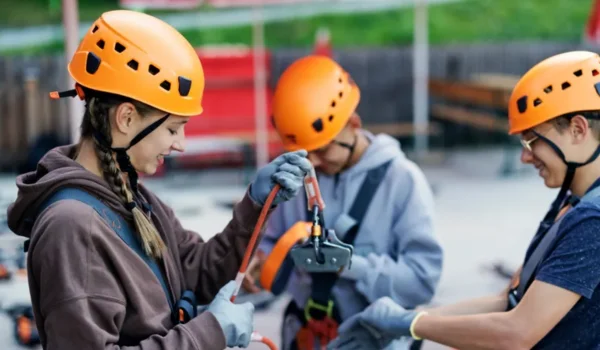
- Safety Starts with Activity Design
Safety begins before a visitor enters an activity.
A properly designed adventure attraction considers factors such as:
- Height
- Participant movement
- Maximum expected load
- Entry and exit points
- Fall exposure
- Equipment requirements
- Emergency access
- Staff observation points
- Weather conditions
- Expected visitor flow
For example, a children’s low-rope course should not simply be a smaller version of an adult high-rope course. The height, obstacles, equipment and operating procedures should be appropriate for the intended participants.
The basic principle is simple:
An activity should be designed around controlled risk, not uncontrolled danger.
- Safety Equipment Protects Participants
Adventure activities often depend on specialised equipment.
Depending on the attraction, equipment may include:
- Helmets
- Harnesses
- Carabiners
- Safety lanyards
- Ropes
- Belay systems
- Pulleys
- Climbing equipment
- Life jackets for water-based activities
- Protective gloves
- Appropriate footwear or other protective equipment
Visitors should receive the equipment appropriate to the particular activity.
Equipment alone, however, does not make an activity safe. It must also be correctly selected, fitted, inspected and used according to the applicable operating procedures.
- Staff Training Is a Major Safety Layer
A modern adventure park needs more than employees who can explain how an attraction works.
Staff may need training in areas such as:
- Activity operation
- Equipment use
- Participant briefing
- Risk recognition
- Emergency procedures
- Rescue procedures
- First aid
- Communication
- Crowd management
- Weather-related decisions
ATOAI’s current safety-resource framework identifies Safety, Quality Control, Sustainability, Compliance, and Training & Certification as key pillars for responsible adventure-tourism operations.
This demonstrates an important point: safety is an operational system rather than a one-time installation.
- Visitors Are Briefed Before Activities
Before participating in an adventure activity, visitors should understand how to use the equipment and what behaviour is expected.
A briefing may cover:
- How to wear the harness
- How to use safety attachments
- Where to place hands and feet
- How to move between platforms
- What not to do
- How to communicate with staff
- What to do if they become uncomfortable
- How to exit the activity
A short briefing can prevent mistakes caused by misunderstanding rather than equipment failure.
- Height, Weight and Age Restrictions
Adventure activities are not suitable for everyone.
A park may establish restrictions based on:
- Minimum age
- Minimum height
- Maximum weight
- Physical ability
- Equipment compatibility
- Activity difficulty
These restrictions are not necessarily designed to discourage visitors. They help ensure that the equipment and activity are appropriate for the participant.
Parents should never assume that an activity is suitable for a child simply because the child wants to participate.
- Equipment Inspection
Safety equipment needs regular inspection.
Adventure parks may have different inspection routines for different types of equipment, including:
Before operation → Daily inspection → Periodic inspection → Detailed maintenance → Replacement when required
Staff may look for signs such as:
- Visible damage
- Excessive wear
- Loose components
- Rope deterioration
- Damaged connectors
- Structural problems
- Abnormal movement
- Missing components
The inspection process should be appropriate to the equipment and the manufacturer’s requirements.
- Structures Are Also Inspected
Visitors often focus on their harness or helmet, but the supporting structure is equally important.
Depending on the attraction, inspections may involve:
- Platforms
- Poles
- Anchoring systems
- Bridges
- Climbing walls
- Cables
- Supporting structures
- Nets
- Stairs
- Railings
A zipline, for example, is not simply a cable. The complete system includes the cable, anchors, platforms, connections, braking/landing arrangements and other components.
- Weather Monitoring
Outdoor adventure activities are affected by weather.
Depending on the activity, operators may monitor:
- Rain
- Lightning
- Strong winds
- Extreme heat
- Visibility
- Storm conditions
- Ground conditions
A responsible operator may temporarily suspend an activity when conditions create unacceptable risk.
This is important because safety decisions sometimes mean stopping an attraction even when visitors want to continue.
- Crowd and Queue Management
Overcrowding can create operational problems even when the attraction itself is properly designed.
Modern parks therefore need to manage:
- Number of participants
- Queue length
- Entry intervals
- Activity throughput
- Waiting areas
- Group sizes
- Staff-to-participant supervision
Controlling the number of people on an attraction helps staff maintain visibility and manage participants more effectively.
- Safety Signage
Clear signage helps visitors understand restrictions before they enter an activity.
Signs may communicate:
- Minimum age
- Height requirement
- Weight limit
- Safety instructions
- Prohibited behaviour
- Required equipment
- Activity difficulty
- Entry and exit directions
- Emergency information
Good signage reduces dependence on verbal instructions alone.
- Emergency Response Planning
Even a well-managed adventure park needs an emergency plan.
An emergency system may include:
- First-aid arrangements
- Trained personnel
- Emergency communication
- Rescue equipment
- Evacuation procedures
- Emergency access routes
- Contact arrangements with nearby medical services
- Incident reporting
The exact requirements depend on the activity, location and applicable local regulations.
- Rescue Procedures
Activities involving height require special attention to rescue planning.
Consider a participant who becomes unable or unwilling to continue halfway through a high-rope course.
The park needs a predetermined method for safely bringing that person back to a safe location.
This is why rescue planning should happen before an attraction opens, rather than being improvised during an emergency.
- First Aid and Medical Preparedness
Adventure parks should have appropriate arrangements for handling injuries and medical emergencies.
Depending on the size and activities of the park, preparedness can include:
- First-aid equipment
- Trained first-aid personnel
- Emergency communication
- Clear ambulance access
- Local hospital/medical contacts
- Incident documentation
The level of medical preparedness should correspond to the activities and risks involved.
- Participant Responsibility Matters Too
Safety is a shared responsibility.
Visitors should:
- Follow staff instructions
- Use safety equipment correctly
- Avoid risky behaviour
- Stay within designated areas
- Follow age/height/weight restrictions
- Inform staff about relevant limitations when required
- Avoid participating while impaired
- Stop when instructed by staff
A safety system can become ineffective if visitors deliberately ignore instructions.
- Safety for Children
Children require additional attention because they differ in size, physical ability and risk awareness.
Adventure parks may provide dedicated children’s zones with:
- Lower heights
- Easier obstacles
- Smaller equipment
- Additional supervision
- Age-specific activities
Parents and guardians should still supervise children and follow the park’s instructions.
- Different Activities Need Different Safety Systems
There is no single safety procedure that works for every adventure activity.
For example:
| Activity | Important Safety Considerations |
| Zipline | Harness, cable system, braking/landing, participant limits |
| Rock climbing | Harness, rope/belay system, climbing surface |
| High-rope course | Fall protection, attachment system, rescue procedure |
| Giant swing | Restraint system, structure, controlled operation |
| Archery | Controlled shooting area, equipment handling, supervision |
| Paintball | Protective equipment, field boundaries, supervision |
| ATV | Vehicle controls, designated track, participant suitability |
| Zorbing | Activity area, participant suitability, controlled operation |
The exact procedures should follow the activity’s design, equipment requirements and applicable standards.
- Safety Audits and Quality Control
Safety should not stop with daily inspections.
Operators can use periodic audits to review:
- Equipment condition
- Staff performance
- Training records
- Emergency procedures
- Incident records
- Maintenance
- Signage
- Visitor complaints
- Operational procedures
Regular review helps identify problems before they become serious incidents.
- Incident Reporting Improves Safety
If a visitor slips, falls, becomes stuck or experiences another safety-related incident, recording the event can help identify patterns.
For example, repeated minor incidents at the same obstacle could indicate:
- Poor design
- Inadequate instructions
- Incorrect participant selection
- Equipment issues
- Staff positioning problems
Learning from incidents is an important part of improving future operations.
- Insurance and Legal Compliance
Adventure parks also need to consider applicable insurance and legal requirements.
Depending on the location and activity, operators may need to examine requirements relating to:
- Business permissions
- Local licences
- Safety regulations
- Labour and staff requirements
- Fire safety
- Building/structural permissions
- Public liability considerations
- Activity-specific requirements
There is no single nationwide licence that automatically covers every adventure park activity in India. Safety and tourism regulation can involve State/UT and local authorities.
The Ministry of Tourism has repeatedly clarified that safety and tourism development at adventure sites are primarily the responsibility of State Governments and UT administrations, while the central ministry provides national strategies and model guidelines.
- Modern Adventure Parks Use a Layered Safety System
The strongest safety approach is not one safety feature but several layers working together.
A simplified model looks like this:
Safe Design
↓
Quality Equipment
↓
Inspection & Maintenance
↓
Trained Staff
↓
Visitor Screening & Briefing
↓
Supervision
↓
Weather & Capacity Monitoring
↓
Emergency & Rescue Preparedness
↓
Incident Review & Continuous Improvement
If one layer fails, the other layers can help reduce the consequences.
What Should Visitors Check Before Choosing an Adventure Park?
Visitors can ask a few simple questions before participating:
- Does the park clearly display activity restrictions?
- Are staff present at the activity?
- Is safety equipment provided and properly fitted?
- Does the operator provide a safety briefing?
- Are activities stopped during unsuitable weather?
- Are children separated into appropriate activity zones?
- Are emergency arrangements clearly communicated?
- Does the park appear to maintain its equipment properly?
These questions cannot guarantee safety, but they can help visitors identify whether an operator appears to take safety seriously.
Is Adventure Park Safety 100% Guaranteed?
No recreational or adventure activity can realistically be described as completely risk-free.
The objective of a professional safety system is to identify foreseeable risks, reduce them through design and procedures, supervise participants and maintain preparedness for emergencies.
The Ministry of Tourism’s current framework is intended to establish a comprehensive and standardised approach, but its implementation and enforcement involve States and UTs. In March 2026, the Ministry again stated that States and UTs had been asked to maintain strict oversight and ensure adherence to safety regulations and licensing norms.
Final Takeaway
Modern adventure parks protect visitors through a combination of safe attraction design, suitable equipment, trained staff, participant screening, activity briefings, inspections, weather monitoring, crowd control, emergency planning and continuous safety review.
The most important lesson is that safety is not a helmet, harness or warning sign alone. It is an entire operating system that begins with how an activity is designed and continues through maintenance, staff training, visitor participation and emergency response.
For visitors, the best approach is simple: follow instructions, respect activity restrictions and never treat safety rules as optional.
For adventure-park operators, safety should remain the foundation of the visitor experience—not an afterthought added after the attractions are built.