Adventure parks and amusement parks are both popular destinations for entertainment, family outings and recreational activities. But they are designed around different kinds of experiences.
An amusement park generally focuses on rides, games, entertainment attractions and family recreation. An adventure park places greater emphasis on active participation, physical challenges, outdoor experiences and adventure-oriented activities.
The difference is not always absolute. Some modern parks combine amusement rides, adventure activities, water attractions and themed experiences in the same destination.
So, if you are deciding between an adventure park and an amusement park, the right choice depends on what kind of experience you want.
Adventure Park vs Amusement Park: Quick Comparison
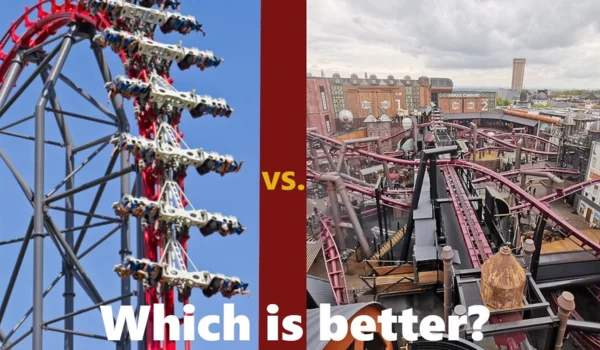
| Feature | Adventure Park | Amusement Park |
| Main focus | Adventure and active experiences | Rides and entertainment |
| Typical activities | Zipline, rope course, climbing, obstacles | Roller coaster, Ferris wheel, carousel, rides |
| Physical participation | Usually higher | Usually varies by ride |
| Natural environment | Often important | Usually purpose-built |
| Thrill | Physical/adventure-based | Ride-based |
| Suitable for families | Yes | Yes |
| Suitable for young children | Depends on activities | Often many child-friendly rides |
| Team activities | Common | Less central |
| Skill/coordination | Often important | Usually less important |
| Outdoor exposure | Usually high | Usually high, but varies |
| Main experience | “I did it” | “I rode it” |
The distinction is a useful generalisation rather than a strict legal classification. In India, the Ministry of Tourism treats adventure tourism as a distinct niche involving physical activity, natural environment and/or cultural immersion, with soft and hard adventure categories.
What Is an Adventure Park?
An adventure park is a recreational destination built around activities that require participants to move, balance, climb, navigate, explore or overcome challenges.
Typical activities may include:
- Ziplining
- Rope courses
- High-rope courses
- Climbing walls
- Rappelling
- Obstacle courses
- Balance bridges
- Commando nets
- Archery
- Treasure hunts
- Cycling challenges
- Team activities
Some activities are physically demanding, while others are designed primarily around coordination, balance or problem-solving.
The Ministry of Tourism’s adventure-tourism framework distinguishes between hard adventure activities, which require greater skills and experience, and soft adventure activities, which generally involve lower levels of risk and are undertaken mainly for recreation and fun.
What Is an Amusement Park?
An amusement park is generally built around a collection of entertainment rides, games and attractions.
Common examples include:
- Roller coasters
- Ferris wheels
- Merry-go-rounds
- Bumper cars
- Drop rides
- Family rides
- Children’s rides
- Arcade or carnival-style games
- Shows and entertainment attractions
An Indian regulatory/tax context has also described an amusement park as a permanent place where different types of amusements, including games or rides, are provided for admission-paying visitors.
The core idea is:
Adventure Park = participate in the challenge
Amusement Park = experience the ride or attraction
Of course, many parks combine both.
- The Biggest Difference Is the Type of Experience
The easiest way to understand the difference is to consider what the visitor actually does.
At an amusement park, you might:
Queue → Board a ride → Experience the ride → Exit
At an adventure park, you might:
Receive instructions → Wear equipment → Perform an activity → Complete a challenge
This makes adventure parks generally more participatory.
- Adventure Parks Usually Involve More Physical Activity
Adventure activities can require:
- Walking
- Climbing
- Balancing
- Jumping
- Crawling
- Cycling
- Pulling
- Stretching
The level of physical activity varies considerably by attraction.
For example, a treasure hunt may require relatively little physical exertion, while a high-rope course may require considerably more.
Amusement-park rides can also involve physical sensations such as acceleration, spinning and sudden movement, but visitors generally do not have to physically complete the ride themselves.
- Amusement Parks Are More Ride-Centred
The traditional amusement-park experience revolves around mechanical or entertainment attractions.
Examples include:
Thrill rides
Roller coasters and high-intensity rides.
Family rides
Attractions designed for parents and children together.
Children’s rides
Smaller rides designed for younger visitors.
Scenic rides
Ferris wheels, trains and similar attractions.
Games
Games and entertainment activities.
The industry classification for amusement and theme parks includes attractions such as mechanical rides, carousels, games, shooting galleries, shows and themed exhibits.
- Adventure Parks Often Use Natural or Outdoor Settings
Adventure parks are frequently designed around outdoor environments.
A park may use:
- Trees
- Hills
- Open land
- Natural terrain
- Forest-like surroundings
- Lakes or rivers
- Rural landscapes
This is particularly relevant to adventure tourism, where the Ministry of Tourism identifies natural environment as one of the defining elements of the broader adventure-tourism experience.
However, not every adventure park is outdoors. Indoor adventure parks are also increasingly common.
- Amusement Parks Can Be More Suitable for Ride Lovers
If you enjoy:
- Roller coasters
- Giant wheels
- Spinning rides
- Drop towers
- Bumper cars
- Family rides
an amusement park may be the better choice.
The experience is primarily about the sensation and entertainment provided by the attraction.
You don’t necessarily need to be physically active to enjoy it.
- Adventure Parks Are Better for People Who Like Active Experiences
Adventure parks can be a better choice if you enjoy:
- Trying new challenges
- Physical activities
- Climbing
- Heights
- Outdoor experiences
- Team competitions
- Problem-solving
- Exploring
For some visitors, the attraction is not simply the thrill.
It is the feeling of completing something themselves.
- Adventure Parks Often Require More Participation
Consider a zipline.
At an amusement park, you may simply sit in a ride vehicle.
At an adventure park, you may need to:
- Attend a briefing
- Wear a harness
- Follow the instructor’s instructions
- Move to the launch point
- Perform the activity
- Complete the course
This creates a different psychological experience.
You are not simply a passenger.
You are a participant.
- Which Is Better for Families?
Both can be excellent for families.
The better choice depends on the family’s interests and the children’s ages.
Choose an Adventure Park if:
- Children enjoy physical activities
- Parents want to participate too
- The family likes outdoor experiences
- Everyone enjoys challenges
- The park has age-appropriate activities
Choose an Amusement Park if:
- The family prefers rides
- There are very young children
- Different age groups need many ride options
- Some family members do not want physically demanding activities
For families with very young children, checking minimum age, height and other restrictions is particularly important at adventure parks.
- Adventure Parks Can Be More Team-Oriented
Many adventure activities can be completed as groups.
Examples include:
- Team obstacle courses
- Treasure hunts
- Group challenges
- Rope challenges
- Strategy games
- Team races
This makes adventure parks particularly attractive for:
- Friends
- School groups
- Corporate teams
- Youth groups
- Family groups
The Ministry of Tourism’s adventure-tourism strategy also places emphasis on skill development, capacity building and responsible adventure-tourism practices.
- Amusement Parks Usually Offer a Wider Variety of Rides
A large amusement park may have attractions for several age groups simultaneously.
For example:
Toddlers → Children’s rides → Family rides → Thrill rides
This can make amusement parks convenient for large families where everyone wants different types of entertainment.
Adventure parks can also have multiple difficulty levels, but their activities are generally more closely connected to adventure or active participation.
- What About Children?
This is one of the most important differences.
A child may be able to enjoy an amusement-park ride simply by meeting the ride’s height requirement.
An adventure activity may additionally require:
- Minimum age
- Minimum height
- Maximum weight
- Physical ability
- Ability to follow instructions
Requirements vary by operator and activity.
India does not have one universal age/height/weight requirement covering every adventure-park activity, so visitors should check the specific park’s rules before booking.
- What About Teenagers?
Teenagers often have a wide choice at both types of parks.
Adventure Park
They may prefer:
- Zipline
- High ropes
- Climbing
- Obstacle courses
- Team competitions
Amusement Park
They may prefer:
- Roller coasters
- Thrill rides
- Drop rides
- Spinning attractions
The choice largely depends on whether they prefer physical adventure or mechanical thrill.
- What About Adults?
Adults can enjoy both.
An amusement park may be ideal for adults who simply want:
Relaxation + Entertainment + Rides
An adventure park may be better for adults looking for:
Challenge + Physical Activity + Outdoor Experience
Adventure parks can also work particularly well for corporate and group outings.
- Which Is More Physically Demanding?
Generally, adventure parks are more likely to require active physical participation.
For example:
Rope course → Climb → Balance → Move → Complete
An amusement ride may involve:
Sit → Secure harness → Ride → Exit
But this is not a universal rule.
A highly physical adventure park may be demanding, while a simple family-oriented adventure park may be relatively easy.
Similarly, some amusement rides can create intense physical sensations even though the passenger is seated.
- Which Is More Suitable for People Afraid of Heights?
This depends on the attractions.
Adventure parks can contain:
- High ropes
- Zipline
- Climbing walls
- Elevated bridges
which may involve significant height exposure.
Amusement parks can also contain:
- Ferris wheels
- Drop towers
- Roller coasters
- Elevated rides
Therefore, people with a fear of heights should check the individual attractions rather than assuming one park category is automatically better.
- Safety Is Important at Both
Neither type of park should be considered automatically “safe” or “unsafe” simply because of its category.
The risks are different.
Adventure parks may involve:
- Heights
- Ropes
- Climbing
- Physical exertion
- Terrain
Amusement parks may involve:
- High-speed rides
- Acceleration
- Spinning
- Mechanical movement
Adventure-tourism safety is specifically addressed through India’s national framework and guidelines. The Ministry of Tourism has also circulated model adventure-safety guidelines to States and Union Territories for adoption or updating of safety protocols.
Visitors should follow the operator’s instructions and activity-specific restrictions in either type of park.
- Adventure Park vs Amusement Park for School Trips
For school groups, both can work—but for different objectives.
Adventure Park
Better suited to:
- Teamwork
- Physical activity
- Outdoor learning
- Problem-solving
- Challenge-based experiences
Amusement Park
Better suited to:
- Entertainment
- Recreation
- Group fun
- Ride experiences
- Family-style attractions
If the school wants a more structured experiential activity, an adventure park may provide more opportunities for participation.
- Adventure Park vs Amusement Park for Corporate Events
Adventure parks can be particularly useful for corporate groups because activities can be structured around:
- Teamwork
- Communication
- Leadership
- Problem-solving
- Group challenges
Amusement parks can provide a more relaxed employee-outing experience.
So:
Team-building objective → Adventure Park
Relaxation and entertainment → Amusement Park
But companies can also combine both approaches depending on the venue.
- Which Is Better for a Date or Friends’ Outing?
There is no universal answer.
Adventure Park
Choose it if you want:
- Active fun
- Challenges
- Photos
- Competition
- New experiences
Amusement Park
Choose it if you want:
- Rides
- Entertainment
- Thrills
- Food
- A relaxed outing
For a group of friends, the deciding factor is usually the type of entertainment everyone enjoys.
- What About Indoor Parks?
Indoor adventure parks have changed the traditional distinction.
Today, you can find indoor venues offering:
- Trampolines
- Climbing
- High ropes
- Zipline-style attractions
- Obstacle challenges
This means adventure does not always mean outdoor.
Likewise, amusement parks can contain adventure-style attractions.
The categories can therefore overlap.
- Can One Park Be Both?
Yes.
A modern entertainment destination may include:
Amusement rides + Adventure activities + Water attractions + Food + Events
In fact, some tourism policies explicitly recognise large theme-park projects that integrate amusement, adventure and water rides along with other experiences and amenities. Odisha’s amended 2026 tourism policy, for example, describes theme parks as complexes that can integrate amusement, adventure and water rides among other experiences.
So the categories should not always be treated as completely separate.
- Adventure Park vs Amusement Park: Cost for Visitors
There is no universal rule that one is cheaper.
The final cost can depend on:
- Number of activities
- Ticket structure
- Location
- Park size
- Included attractions
- Premium experiences
- Food
- Parking
- Seasonal pricing
An adventure park may have an entry ticket plus activity charges.
An amusement park may have a ticket that includes several rides.
Some parks use hybrid pricing.
Therefore, compare what is included, not just the headline ticket price.
- Which Gives Better Value?
Value depends on what you want.
If you love roller coasters:
Amusement Park = better value
If you love climbing and ziplining:
Adventure Park = better value
If you want family entertainment:
Either can be suitable
If you want team-building:
Adventure Park may be more appropriate
If you want a relaxed ride-focused day:
Amusement Park may be better
- Simple Decision Guide
Ask yourself one question:
“What do I want to do today?”
If your answer is:
“I want to ride exciting attractions.”
→ Choose an Amusement Park.
“I want to climb, balance and challenge myself.”
→ Choose an Adventure Park.
“I want activities for young children.”
→ Compare both parks’ child-friendly attractions.
“I want a team-building experience.”
→ Adventure Park may be the better fit.
“I want a relaxed family entertainment day.”
→ Amusement Park may be more suitable.
“I want both.”
→ Look for a hybrid/theme-park destination.
Adventure Park vs Amusement Park: Final Comparison
| Category | Adventure Park | Amusement Park |
| Core experience | Active adventure | Entertainment rides |
| Main attraction | Challenges and activities | Rides and attractions |
| Physical effort | Usually higher | Usually lower for visitors |
| Natural setting | Often important | Usually purpose-built |
| Teamwork | Common | Usually secondary |
| Children | Depends on restrictions | Many dedicated rides |
| Teenagers | High appeal for active teens | High appeal for thrill-seeking teens |
| Families | Good | Excellent |
| Corporate groups | Very suitable | Suitable |
| School groups | Strong for experiential activities | Strong for recreation |
| Fear of heights | Depends on activities | Depends on rides |
| Safety focus | Activity-specific adventure safety | Ride/operator safety |
| Best for | Challenge and participation | Rides and entertainment |
Final Takeaway
The simplest distinction is:
Adventure Park = You participate in the adventure.
Amusement Park = You experience the attraction or ride.
Adventure parks generally focus on activities such as climbing, rope courses, ziplining, obstacles and other active experiences. Amusement parks generally centre on rides, games and entertainment attractions.
But modern parks increasingly combine different formats, so the name alone does not tell you everything.
Before booking, look at the actual activity list, age restrictions, safety procedures, ticket inclusions and facilities.
If you want challenge, physical activity and participation, choose an adventure park.
If you want rides, entertainment and mechanical thrills, choose an amusement park.
And if you want a mixture of both, look for a destination that combines adventure, amusement and other recreational experiences.